
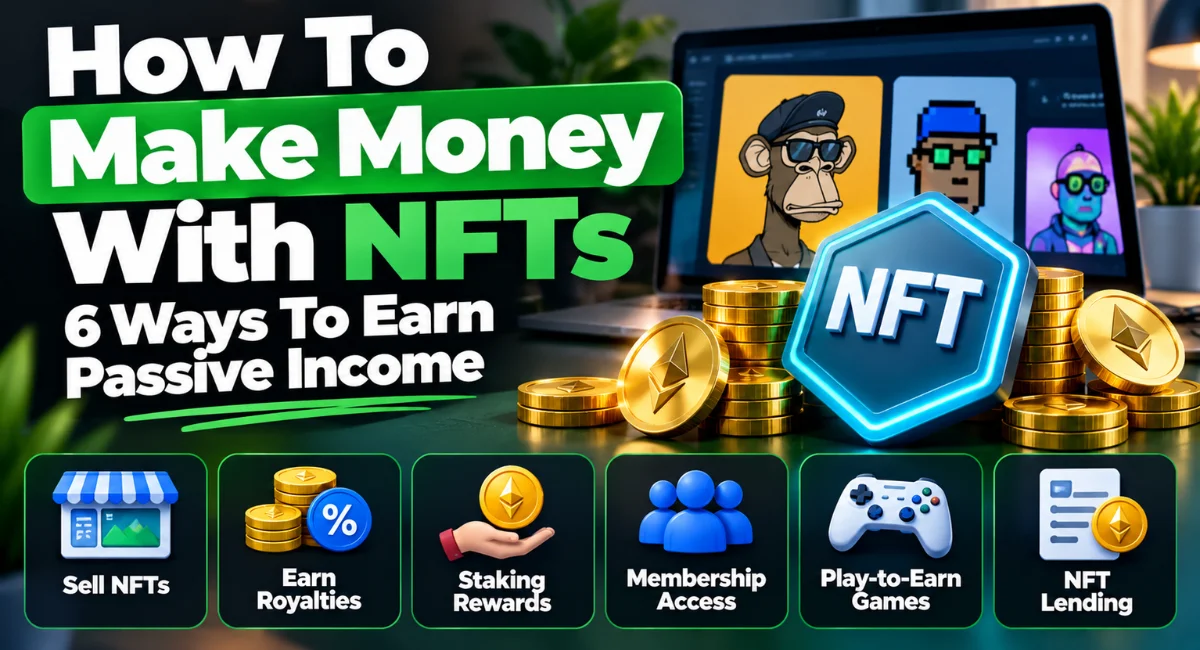

If you are looking for ways to make money with NFTs, this article will tell you about renting, flipping, staking, and investing in companies with exposure to the technology.
Before I continue, please be aware that nothing in this article is financial advice, NFTs are considered highly volatile assets, and people should only invest what they are willing to lose.
Before we get to the making money with NFTs part of this article, let’s first look at some background info on NFTs.
What Is An NFT?
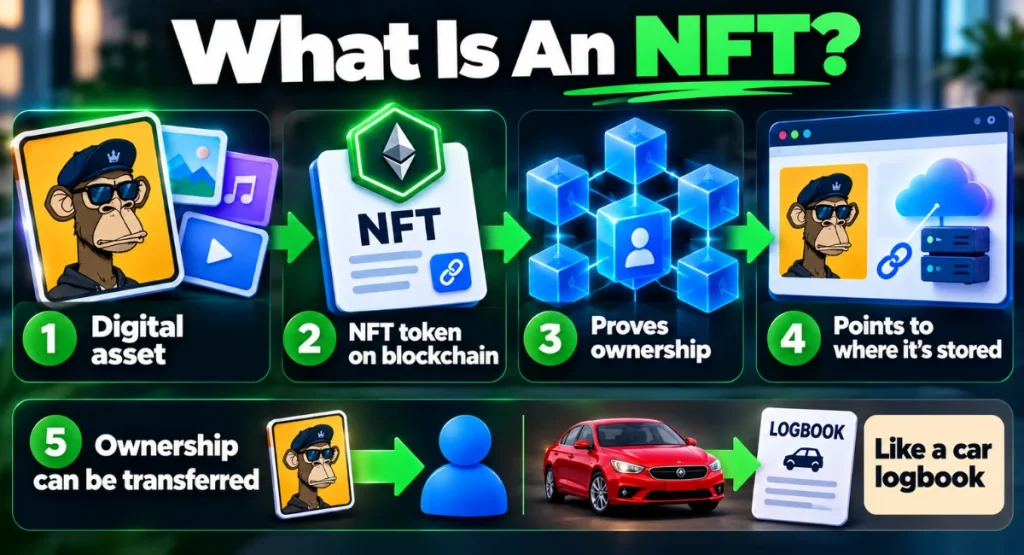
So, what’s an NFT? It stands for non-fungible token.
Basically, it’s a unique digital asset recorded on a blockchain. The NFT itself doesn’t hold the real item, it works more like a receipt on a public ledger anyone can view.
In this way, the NFT points to the location where the asset is stored on the internet.
NFTs contain unique information that identifies the owner. Since the NFTs are stored on the blockchain, everyone can see and verify ownership at all times.
Since NFTs verify ownership of a digital asset, the ownership of the said asset is transferred to a new party when an NFT is sold.
It’s kinda like when you sell a car; when you buy or sell a car the logbook representing ownership of the car also needs to be transferred to the new owner. In this way, NFTs are like the car’s logbook.
Since every NFT is 100% unique, it cannot be traded in the same way you can trade cryptocurrency like Bitcoin. This is why NFTs are called non-fungible tokens.
Where Does an NFTs Value Come From?
Some non-fungible tokens can sell for huge amounts of money, while others are worth almost nothing.
So, what gives an NFT value?
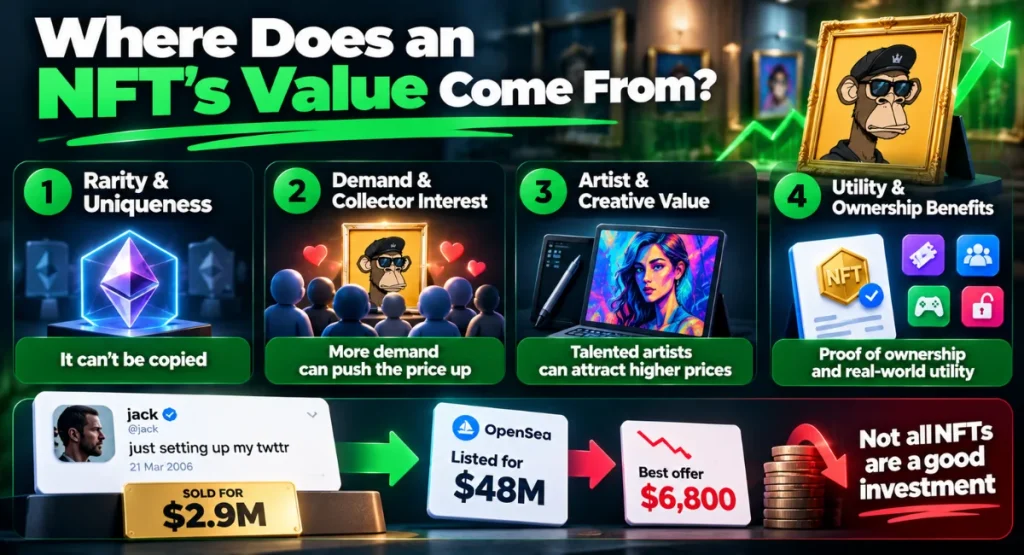
Since NFTs are unique digital assets that can’t be copied, they attract people with a ‘collector mentality. Ultimately, it’s the collective interest of would-be purchasers that drives the price.
In reality, something is only as valuable as much as someone is willing to pay for it. But if many people want to be the owner of the item then the price can go up considerably.
However, even this does not mean that any given NFT will be a good investment.
Take the famous Jack Dorsey Twitter NFT for example…
A 2006 tweet by Twitter CEO Jack Dorsey, sold for $2.9m in March 2021. The buyer saw value in this NFT since it was the first-ever tweet created on the Twitter platform.
The buyer then tried to resell the NFT on the OpenSea platform for $48m. However, the best offer he received was $6,800 so he lost a huge amount of money on his purchase!
Another way people see value in NFTs is when a talented artist creates a piece of art digitally. In this way, the price of NFTs may vary widely, depending on the artist’s skill level.
The utility of NFTs is another factor determining their value. Proof of ownership is one major component. While anyone can take a picture of an NFT, blockchain technology unequivocally states true ownership publically.
How Can I Buy an NFT?
The majority of trading platforms where you can buy and sell NFTs will require you to use cryptocurrency to make a purchase. However, are a small handful of platforms like OpenSea and MoonPay that will accept credit cards.
To use cryptocurrency to buy NFTs (and to have more choice between trading platforms) you’ll need to set up a cryptocurrency wallet. There are lots to choose from, but some of the most popular crypto wallets include Coinbase, Binance, and MetaMask wallets.
Once your digital wallet is set up, you can begin purchasing cryptocurrency around the market value at the time. If you’re purchasing a popular currency like Bitcoin, then you’ll likely have more flexibility over what you can buy with it later.
While accumulating Bitcoin in your wallet, you can begin looking at NFT trading platforms to see what you want to buy.
At the moment, OpenSea is the biggest NFT marketplace, and it trades in all kinds of assets. For example, you can buy digital art at a cheap price and then make it more unique for reselling. Or, you can find very high-priced items to buy and hold or resell later.
How Can I Showcase My NFTs?
There are a number of ways you can promote an NFT and attract interested buyers. For example, you can share them on social platforms like Instagram, Twitter, and Reddit.
Discord is also another popular platform to join if you want to promote your digital items to a wider audience. Some sellers also go as far as using paid advertising or organizing and hosting events in the Metaverse where they can showcase their artwork.
How Can I Sell an NFT?
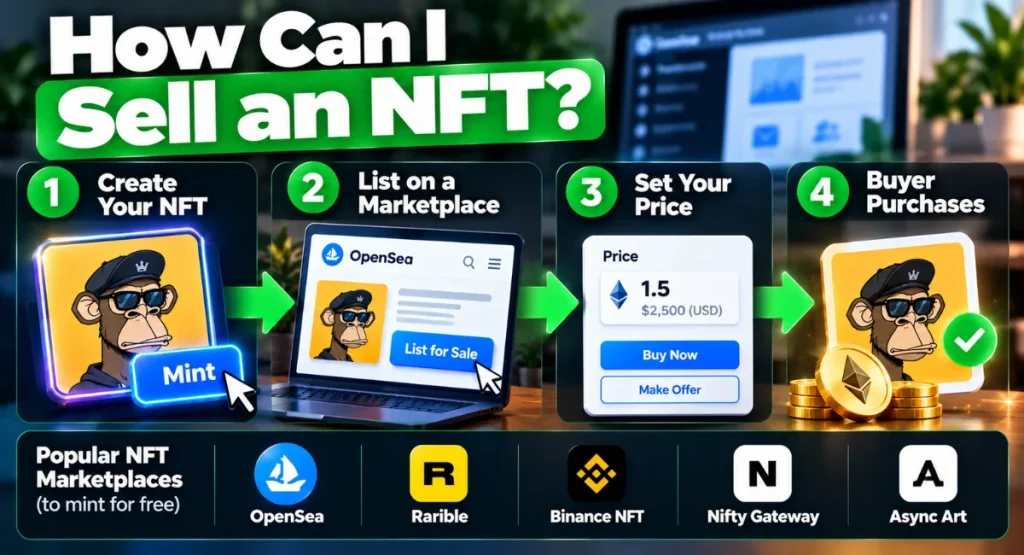
Before you can actually sell your NFT, you first need to mint it. The minting process simply means you’ve uniquely published your NFT on the blockchain to make it a purchasable item.
Next, you list your NFT on a marketplace like OpenSea and set your asking price. Buyers can purchase it outright or make you an offer.
Now, marketplaces do take a cut when a sale happens. The exact fee, and how royalties work, has shifted a fair bit over the years.
So before you list, just check the current rate on the platform. It’ll be right there in their help docs.
There are various minting services out there to choose from. Here are a few you can use to mint your NFTs for free:
- OpenSea
- Rarible
- Binance NFT
- Nifty Gateway
- Async Art
How Will I Know if My NFT Sells?
Depending on which platform you’re using to sell an NFT, keep an eye on the sales page for the NFT you’ve listed for sale.
If someone’s accepted your price or made you an offer, you’ll be able to see it, accept it or reject it on the sales page.
Once you’ve accepted the offer, the funds will be sent to your wallet as cryptocurrency. You can then use the crypto to buy other items, or exchange it for cash.
Related Article: How much does it cost to make an NFT
6 Ways To Make Money With NFTs
There are a few ways you can make money through NFTs. However, at the moment the two most common ways are either to buy and resell an NFT at a profit or learn how to make them yourself and sell your work.
Most commonly, people either look to buy an NFT at a low sale price or sell it later on for a profit.
Renting Out Your NFTs
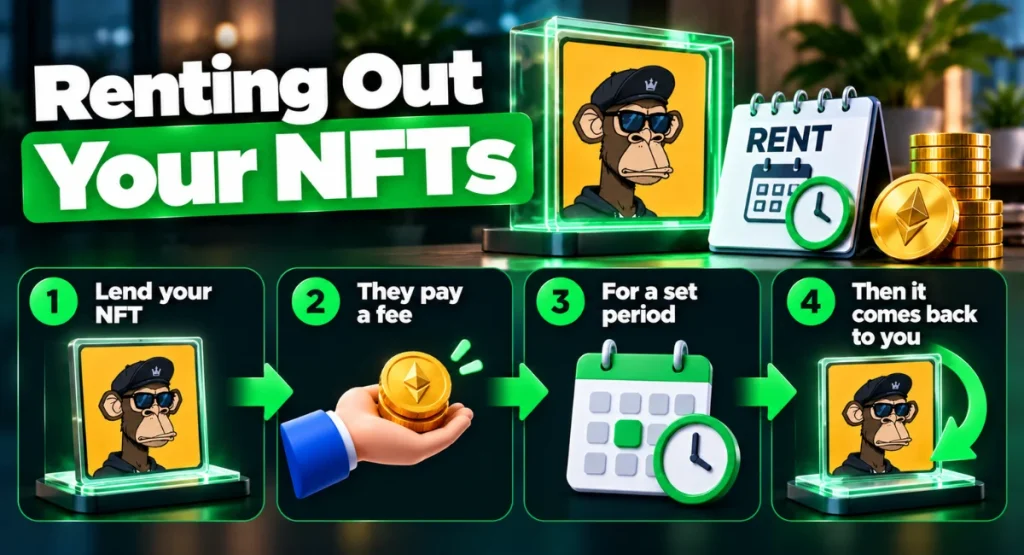
So here’s the idea. You lend your NFT to someone for a set period, they pay you a fee, and when the timer runs out, the asset comes straight back to you. It’s kind of like being a digital landlord, without the broken boiler calls.
The appeal is pretty clear. It’s a way to earn from an NFT you want to keep, without actually parting with it.
Now, is there actually a queue of people waiting to rent?
That’s where it gets tricky. Outside of in-demand gaming assets or membership tokens that unlock something useful, this kind of demand is genuinely rare.
Platforms like reNFT were purpose-built for this, letting you set your own price and rental length. The thing is, NFT rentals never really took off the way people hoped. At least one rival platform shut down already, citing almost no traction.
So if you’re curious about this route, just check that whatever platform you’re eyeing is still active and well reviewed before you dive in too deep.
NFT Royalties
Here’s the old story: you mint an NFT, set a royalty percentage (say 10%), and every time it resells, that chunk lands in your wallet. Passive income that keeps paying out forever.
It felt like finally getting a fair deal as a creator, and I completely get why so many artists rallied around it.
But the landscape shifted, and if you’re reading older articles, you’re getting the wrong picture.
In August 2023, OpenSea made creator fees optional for new collections. By February 2024, enforcement for older collections was gone too.
What does that actually mean? Buyers on many marketplaces can now simply choose not to pay your royalty when they resell.
So royalties aren’t the guaranteed passive income stream they were once pitched as. They can still add up if you’ve built a genuinely loyal collector base that wants to support you, and a 10% cut of a big resale is still a lovely thing to see land.
Just go in knowing it’s a nice bonus, not a built-in forever payout.
NFT Yield Farming
So what actually is NFT yield farming?
It’s basically locking your NFTs, or some crypto tokens, into a DeFi platform’s pool.
In return, the platform pays you rewards in its own token. A bit like earning interest, but the interest is a volatile cryptocurrency rather than something predictable.
And this is the important part.
Those reward tokens can swing wildly in value, and the platform itself could fail. It’s not a savings account.
If you’re curious about how it all works under the bonnet, there’s a good breakdown in this NFT farming explainer.
NFT Staking
NFT staking is kind of like earning interest on a savings account, except you’re locking your NFT into a DeFi platform’s smart contract instead of a bank. The platform rewards you with crypto while your NFT sits there doing its thing. You can usually withdraw it later, which is the clever bit.
NFT staking is similar to yield farming since it needs a Proof of Stake (PoS) in order to operate in this way. With the PoS in place, NFT holders can be appropriately awarded.
So, why do this?
In a nutshell, once NFT holders have locked up their assets, they can receive awards based on the number of NFTs that have been staked and the annual percentage yield (APY).
Want to know more about NFT staking? Read this article here.
Earn NFTs By Providing Liquidity
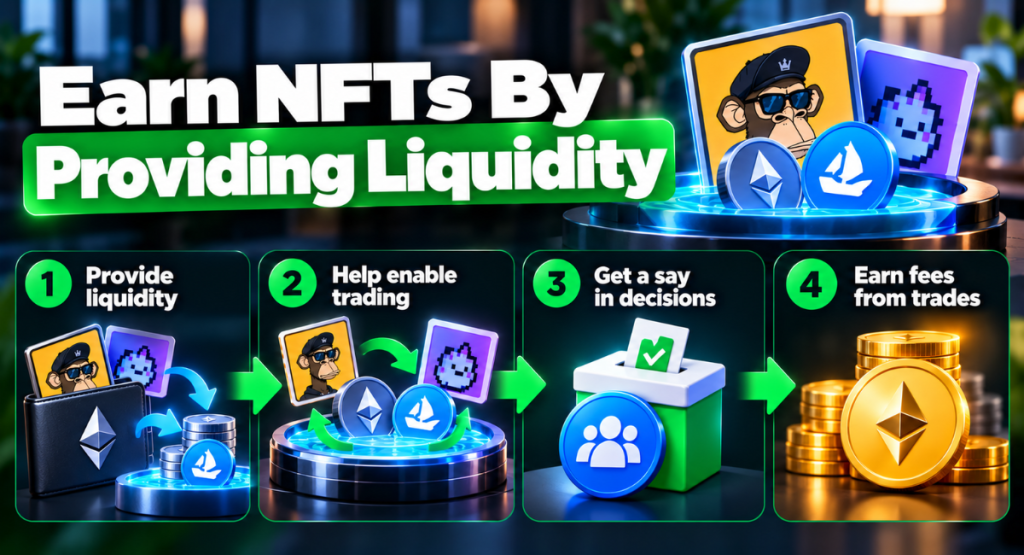
Providing liquidity for NFTs is kinda like being an investor. Users that invest in NFTs are referred to as liquidity providers (LP).
If you’re an LP then you can use your liquidity provider tokens to vote and have a say in the decision-making process involved with the NFTs you’re invested in.
Liquidity providers are also known as market makers since they can have a huge influence over the crypto market. Their involvement helps in the process of decentralized trading, and in return, LPs are paid in fees earned from any trades that are made on the platform.
This method appeals to a lot of wealthy investors. Basically, you gotta have a lot of money behind you to be a liquidity provider. But if that’s you then this can be another great passive income stream for you.
Promote NFTs With Affiliate Marketing
Affiliate marketing is pretty simple. You share a referral link, someone clicks it and buys something, and you earn a commission. That’s it.
Now, during the NFT boom, loads of marketplaces and projects launched affiliate programmes with flashy payouts. But here’s the thing… a lot of those have quietly closed up shop since the hype faded.
The steadier version of this idea? Promoting the software and tools that creators actually use month after month, regardless of what the market is doing.
If you want to build something that outlasts a trend, have a read through my affiliate marketing guides.
Easier Ways To Make Money From Digital Art In 2026
Right, so you liked the sound of NFTs. I get it. The idea of creating something digital and earning from it is genuinely exciting.
But here’s the bit a lot of people skip: you don’t need a blockchain to sell digital art. Not even close.
People are out there right now buying things like printables, templates, ebooks and audiobooks. And with AI tools, you can create them pretty quickly. It’s a lower-risk route to passive income that’s worth a look.
Canva
Canva is basically the go-to for designing stuff that looks professional without needing a design degree.
You can whip up printables, planner pages, social media templates, or wall art and list them on places like Etsy. Build it once, and it’s out there working for you.
The free plan gives you loads to start with, so you can test the water before spending a penny. Grab it with this link.
Designrr
Got a blog post or a video that did well? Designrr turns it into a polished ebook or a lead-magnet PDF.
This is a clever one, because you’re not starting from a blank page. You repurpose content you already have into something people will pay for. It’s all drag and drop, and right now there’s a $27 lifetime deal with this link.
ElevenLabs
ElevenLabs takes text and uses AI to generate a voiceover that sounds surprisingly human.
So if you’ve written a book, or even a short guide, you can turn it into an audiobook without hiring a narrator. It’s a completely different format for the same work. The free plan lets you try it out, which is pretty great, and you can sign up with this link.
Look, NFTs might be flashy. But these tools let you build a little income stream from digital creations without the crypto rollercoaster.
Making Money With NFTs – Final Thoughts
Thanks to blockchain tech, NFTs are an emerging market with a lot of opportunities. Anyone can get involved in this market even if you’re an introvert looking for a side hustle.
While there certainly are people out there making a lot of money with NFTs, there are also a lot of stories about people losing large sums of money on them too.
Nobody really knows where NFTs will settle.
The hype has cooled, sure, but that doesn’t mean the tech is going anywhere. It just means the get-rich-quick crowd has mostly moved on to the next shiny thing.
So if you’re still curious, just go slow. Only ever risk what you can genuinely afford to lose, because this space can turn on a dime.
Talk to people who’ve been around the block, do your own digging, and never let FOMO make the decisions for you.
And look, if the volatility feels a bit much right now, that’s completely fair.
The AI creator tools we covered earlier are a much gentler on-ramp for making money from digital work, with a fraction of the stomach-churning.

Steve West is the founder of entrepreneurnut.com, and has been working online since 2013. He specializes in SEO, YouTube, and affiliate marketing. Besides running his online business, he likes hiking, keeping fit, and eating cookies (which is why he needs to keep fit!)
How To Achieve Money, Time & Location Freedom

Create 15+ Streams of Income in 30-Minutes
- Tap into 15+ Existing Revenue Streams
- Beginner-friendly
- Fast Setup
- No nonsense
- High-ticket products
- Recurring revenue products
- No selling needed
This simple formula shows you how