
This blog is reader supported. If you click one of our links and make a purchase, we may receive a commission at no extra cost to you. In that event we thank you so much, for supporting our blog, it means the world to us. Have a great day!
Last Updated on 20th April 2026
If you’re comparing Skool vs Whop, you’re probably trying to avoid a costly mistake.
On the surface, both platforms help Creators sell memberships, courses, and communities. But once you look closer, they’re built for very different goals.
One is better if you want simple community building and a strong online community. The other is better if you care more about selling digital products, subscriptions, and access-controlled offers.
In this guide, you’ll get a clear, no-fluff breakdown of what each platform does best, where each one falls short, and which option makes more sense for your business model in 2026.
Skool vs Whop: Key Takeaways
- Skool is the better fit if engagement is your top priority. It’s built around community, courses, and a clean, distraction-free experience.
- Whop is the better fit if selling is your top priority. It gives you stronger monetisation tools, more payment flexibility, and built-in merchant of record services.
- Skool is usually easier to learn. It’s simpler, more focused, and works well for coaching groups, memberships, and Course Creators.
- Whop is broader and more flexible. It supports more offer types, including subscriptions, downloads, software access, and communities.
- Both platforms include course delivery and community tools, but in different ways. Skool leans into engagement, while Whop leans into commerce and discoverability.
- Neither platform is perfect for every business. The best choice depends on whether you want a community-first hub or a sales-first platform with built-in video hosting services and payment infrastructure.
Quick Verdict: Which Platform Wins for Your Business Model?
If your main goal is to build a coaching membership, a mastermind, or a paid community with strong engagement, Skool is usually the better choice.
It’s a simpler community platform, it handles online courses well enough for most memberships, and its points, levels, and classroom setup create a more gamified community experience than most alternatives.
If your main goal is digital product sales, subscriptions, downloads, software access, or a more flexible creator storefront, Whop is usually the better fit.
It gives you more ways to sell, stronger checkout options, and a much more commerce-focused setup. That’s great because it can remove friction when you want to monetise faster, not just host a group.
In short:
- Choose Skool if community engagement and retention matter most
- Choose Whop if selling flexibility and monetisation infrastructure matter most
Skool and Whop Platform Overview
At a high level, Skool and Whop solve a similar problem.
They both help people build an audience, sell access, and run a membership business.
But the way they do it is very different.
What is Skool?
Skool is a community platform built mainly for memberships, coaching groups, and simple course-based communities.
Its core focus is not flashy funnels or advanced automation. It’s community engagement.
That’s why many people see it as a strong fit for coaches, consultants, educators, and niche membership owners who care more about interaction than complex tech stacks.
The platform itself describes Skool as a place where you can discover communities or create your own, with both free and paid groups available. Skool describes itself as a community platform.
Skool was founded in 2019 by Sam Ovens and Daniel Kang. On its official About page, the company says it has around 30 employees, is based in Los Angeles, and that Alex Hormozi partnered with Skool in 2024 to launch The Skool Games.
That founder and creator association matters.
It has helped Skool become much more visible among business educators, coaches, and audience-first Creators.
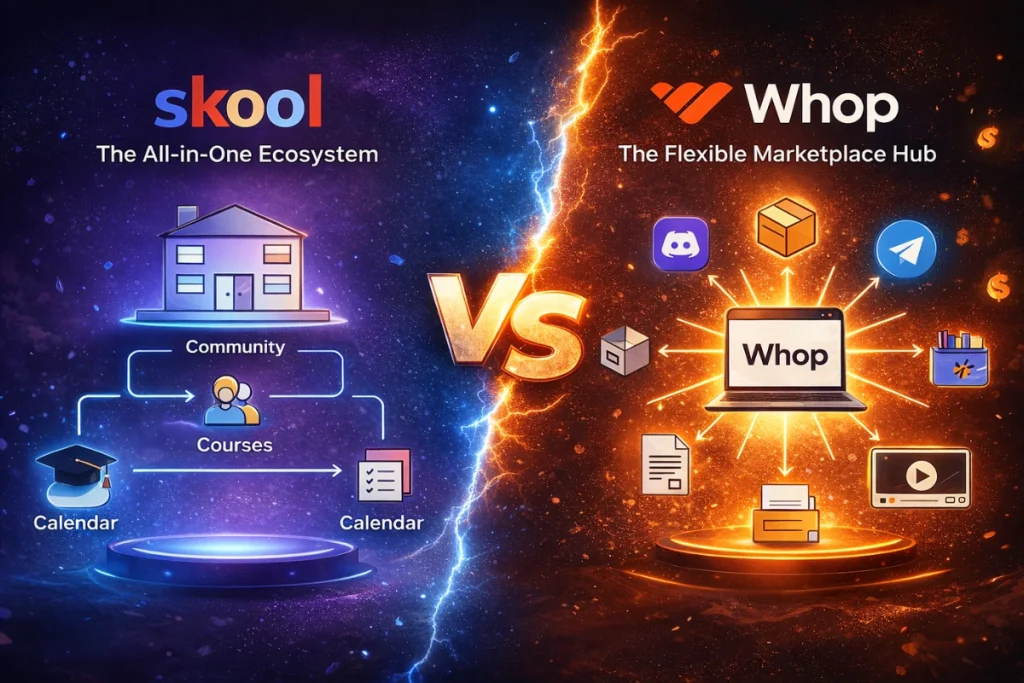
You can think of Skool as a streamlined content management system for memberships, where the main pieces are:
- community feed
- classroom
- calendar
- member profiles
- gamification
That setup is useful because it keeps everything in one place without overwhelming members.
For many Skool communities, that simplicity is the whole point.
What is Whop?
Whop is broader.
It’s best understood as a creator commerce platform that also includes community and course features.
Instead of starting with “How do we make this community more engaging?”, Whop starts with “How do we help people sell more things online?”
That makes it a very different product.
Whop supports memberships, subscriptions, gated communities, downloadable files, software access, and other types of digital products. It also gives sellers a storefront, checkout, recurring billing, and a built-in marketplace.
On its homepage, Whop positions itself as a creator commerce platform with a strong focus on subscriptions, gated access, and marketplace-driven discovery. According to Fortune, 4 million people a month were using Whop by mid-2024, which helps explain why it has become so visible among digital product sellers and creator businesses.
That’s the big clue.
Whop is much more commerce-first than Skool.
It’s especially appealing for founders who want to sell software access, communities, memberships, or creator offers without stitching together lots of separate tools. It also helps that Whop handles payment flow and chargebacks in a more built-in way than most simple community platforms.
This is useful because it can simplify both setup and operations when your main focus is revenue, not just community building.
Whop also gained more attention in the creator world through its official association with Iman Gadzhi, which helped raise its profile among people already familiar with high-ticket offers, creator monetisation, and internet business education.
So while Skool leans toward shared learning experiences, Whop leans toward monetisation infrastructure.
That distinction matters.
Key Features and Standout Highlights
This is where the difference between these two platforms becomes obvious.
Skool is designed to keep people engaged inside the community.
Whop is designed to help you sell, manage access, and grow across multiple offer types.
Skool’s Core Features
Skool keeps its feature set focused.
That’s part of the appeal.
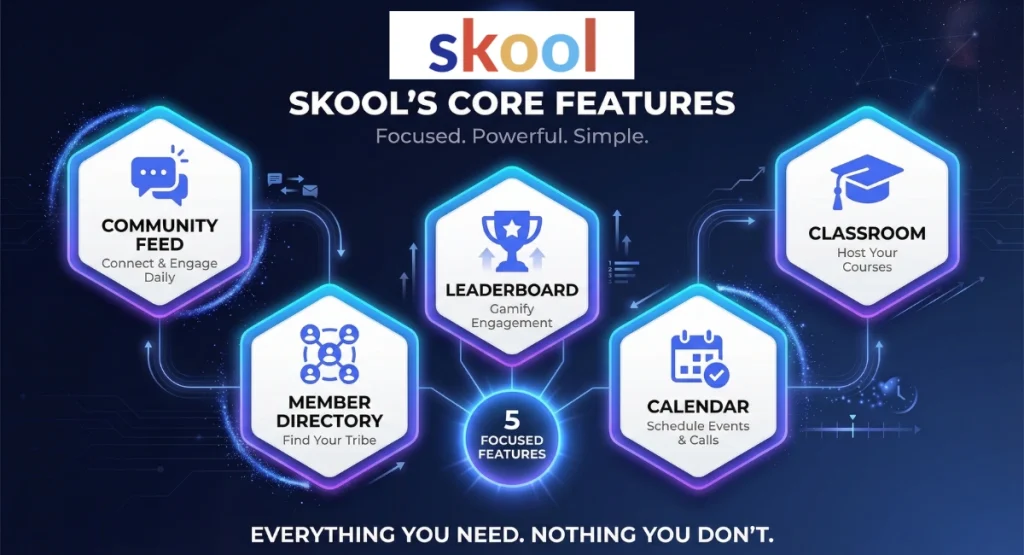
At its core, a Skool Community combines five main areas:
- a community feed
- a classroom for courses
- a calendar for events and calls
- a member directory
- a leaderboard system
The community feed inside Skool is chronological, which means posts appear in order instead of being filtered by an algorithm. That’s great because members are more likely to actually see what you post, which can improve consistency and trust.
The classroom is built for structured content.
You can organise lessons into modules, drip content over time, and keep content organization simple for members. For a coaching membership or educational group, that’s often enough.
Skool also handles Video Hosting inside the classroom, alongside embeds from tools like YouTube or Vimeo, depending on how you want to structure delivery.
That flexibility matters because it lets you choose between native Video Hosting and external embeds based on cost, speed, and convenience.
Then there’s the gamification layer.
This is where Skool stands out.
Points, levels, and leader boards encourage member participation, which can make a huge difference in retention. Instead of members joining, lurking, and disappearing, the platform nudges them to engage more often.
That’s especially useful for communities built around accountability, coaching, or shared learning experiences.
Whop’s Core Features
Whop takes a more modular approach.
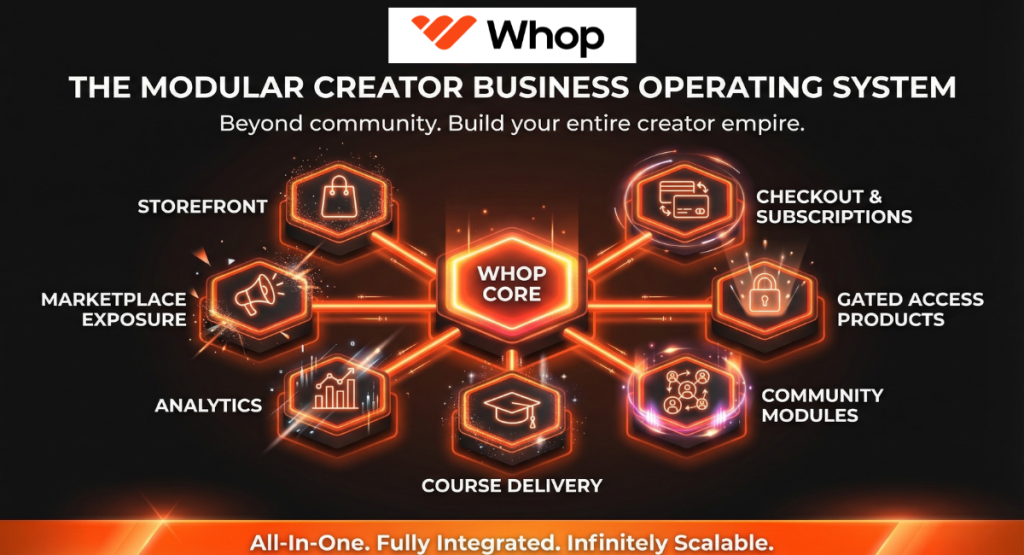
Instead of feeling like a single-purpose community hub, it feels more like a creator business operating system.
At the core, Whop gives you:
- a storefront
- checkout and subscriptions
- gated access products
- community modules
- course delivery
- analytics
- marketplace exposure
Whop’s storefront is one of the biggest differences.
Unlike Skool, Whop is built with selling front and centre, so you can create offers, bundle products, run subscriptions, and use things like promo codes to increase conversions.
That’s valuable because it gives you more control over how you monetise, not just where your members hang out.
Whop also supports a built-in app marketplace, which makes it more flexible than Skool if you want to expand functionality over time.
You can also connect access to external communities, including Discord chats, which is a big plus for creators who already have an audience on Discord or Telegram and want better billing, access control, or customer management.
That hybrid setup can be powerful.
Especially if you already have an existing audience elsewhere.
Whop also includes course and community modules, so it can act as a course platform, but its biggest strength is still the selling side rather than the teaching side.
Its built-in analytics tools are also stronger than what most simple membership platforms offer, which is helpful if you care about tracking churn, conversion, and product performance.
Standout Features: What Really Separates Skool and Whop?
If you strip both platforms down to their core value, the difference is simple.
Skool is built to improve engagement.
Whop is built to improve monetisation.
For Skool, the standout feature is the way gamification shapes behaviour. The points system, levels, and unlockable perks are not just cosmetic. They create a stronger habit loop inside the community.
That matters because most memberships do not fail because the content is bad.
They fail because people stop showing up.
Skool is designed to reduce that problem.
For Whop, the standout feature is its commerce infrastructure. It combines storefronts, subscriptions, access control, payouts, and built-in discoverability in a way that feels much closer to a creator marketplace than a simple membership tool.
That’s a big advantage if your business model is based on selling multiple offers, not just running one group.
Ease of Use and Customization
Ease of use is one of the biggest differences between these two platforms.
If you want the simpler option, Skool usually wins.
Which Platform Is Easier to Learn?
Skool has a cleaner and more focused layout.
Most users can understand the structure quickly because the main navigation is straightforward: community, classroom, calendar, members, and leaderboard. That creates a smoother user experience, especially for people who do not want to spend hours learning a new backend.
This is one of Skool’s biggest strengths.
It feels intentionally limited in a good way.
That can be frustrating if you want deep flexibility, but it is helpful if you want something that members can use without confusion. For coaching offers, masterminds, and a simple membership site, that lower friction can improve adoption.
Whop is more powerful, but it also has more moving parts.
Because it is built around storefronts, products, apps, subscriptions, access rules, payouts, and marketplace discovery, the dashboard can feel busier at first. It is not necessarily hard, but it usually takes longer to understand.
That trade-off is worth it for some businesses.
Especially if selling is the main goal.
How Much Can You Customize?
Neither platform is a true website builder.
That is important to understand upfront.
Skool is very limited when it comes to branding and design. You can add your logo and customise some basics, but you are not getting full control over layouts, colours, or deeply customised sales pages inside the platform.
That is fine for some brands.
Not ideal for others.
Whop gives you a bit more flexibility on the selling side because you are working with a storefront and product pages, but it is still not the same as a full funnel builder or a highly custom website platform.
So if your brand depends heavily on custom design, detailed page layouts, or advanced front-end control, both tools may feel restrictive.
Pricing and Fees
Pricing is where a lot of people make the wrong decision.
Not because the pricing is hidden, but because the “cheaper” option on paper is not always the cheaper option in practice.
Skool Pricing
It offers two plans:
- Hobby: $9/month + 10% platform fee
- Pro: $99/month + 2.9% platform fee
Both plans include unlimited members and course content inside a single community.
That sounds attractive, and for many smaller creators, it is.
The key phrase there is single community.
If you want to run multiple separate Skool communities, you need to pay for each one individually. That can become expensive if your business model relies on multiple niche groups, segmented memberships, or separate branded communities.
For one focused offer, though, the pricing is easy to understand.
And that simplicity is a real benefit.
Skool Annual Pricing Plans
Skool now also offers annual billing, which gives you a lower effective monthly price if you’re happy to pay upfront. If you already know you’ll be using the platform for a while, this can save you a decent bit over the course of the year.
Here are the new annual plan prices:
- Hobby (annual): $7.50/month
- Pro (annual): $82/month
That works out as:
- Hobby annual plan = $90/year, saving you $18 per year compared to paying $9/month
- Pro annual plan = $984/year, saving you $204 per year compared to paying $99/month
So if you choose the Hobby annual plan, your investment will be $90 for the year, which saves you $18 annually versus paying monthly.
If you choose the Pro annual plan, your investment will be $984 for the year, which saves you a more noticeable $204 per year compared to staying on the monthly plan.
The monthly plan prices still remain the same:
- Hobby: $9/month
- Pro: $99/month
So if you’re just testing an idea or you want maximum flexibility, the monthly plans still make sense.
But if you’ve already validated your offer, or you know you’re serious about building a paid community, the annual plans are the smarter financial choice because they lower your effective monthly cost and trim your overhead a bit.
In short:
Go annual if you’re committed and want the lower overall cost
Go monthly if you want flexibility and you’re still experimenting
Whop Pricing
Whop takes a very different approach.
There is no monthly subscription to get started. Instead, you pay as you sell.
Its standard domestic card transaction fee is 2.7% + $0.30. There can also be extra charges for international cards, currency conversion, buy-now-pay-later transactions, and faster payout options.
That makes Whop feel low-risk at first.
No monthly bill. Just sell and pay from revenue.
For newer Creators, that can be appealing because you are not paying before you make money.
But the real cost depends on how you sell.
If you have a high sales volume, lots of smaller purchases, frequent payouts, or you rely heavily on premium payment methods, Whop’s transaction fees can add up faster than expected.
So the “free to start” angle is true, but it is only part of the story.
Which Pricing Model Is Better for Different Businesses?
This is the practical answer.
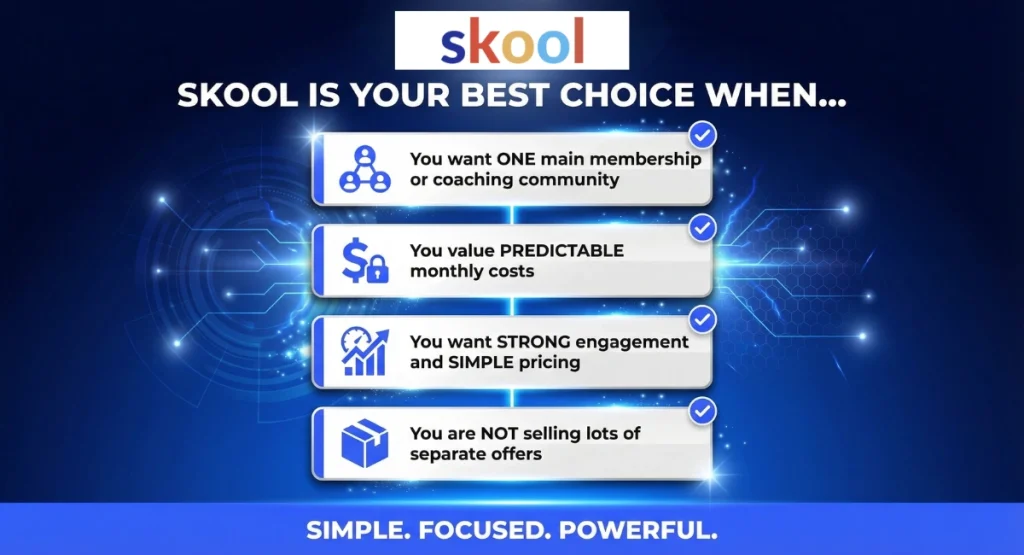
Skool is usually better if:
- You want one main membership or coaching community
- You value predictable monthly costs
- You want strong engagement and simple pricing
- You are not selling lots of separate offers
Whop is usually better if:
- You want to sell multiple offer types
- You care more about flexible monetisation than a simple community setup
- You want marketplace exposure
- You do not mind paying based on usage

There is no universal winner here.
If you run one premium coaching group, Skool may feel cleaner and easier to forecast.