
ActiveCampaign vs HubSpot: Which Is Best for SMB Growth?
Trying to decide between ActiveCampaign vs HubSpot can get expensive fast.
At first glance, both look like strong options. Both offer email marketing, marketing automation, CRM features, landing pages, and AI-powered tools. But once you dig into the details, the real question is not which platform has more features.
It’s which one gives your business the right mix of automation, usability, and value without paying for more platform than you actually need.
If you’re a growing small business, coach, consultant, SaaS company, or lean marketing team, this guide is for you.
You’ll get a clear, fair breakdown of where each platform shines, where HubSpot clearly has the edge, and why ActiveCampaign often makes more sense for SMBs that want stronger automation without enterprise-style pricing.
Key Takeaways
- ActiveCampaign is usually the better fit for growing SMBs that want deeper marketing automation and stronger email marketing without jumping to enterprise-level costs.
- HubSpot is still an excellent platform, especially for businesses that need broader customer relationship management, sales alignment, and more advanced cross-team reporting.
- HubSpot’s Marketing Hub Professional currently starts at $890/month on monthly billing, or $800/month annually, and requires a $3,000 onboarding fee. (hubspot.com)
- ActiveCampaign’s current comparison page shows plans starting at $15/month, with Plus at $49/month and Pro at $79/month for 1,000 contacts. (activecampaign.com)
- If your business is mainly focused on email marketing, automation workflows, and converting leads more efficiently, ActiveCampaign often delivers better value.
- If your business needs a broader platform for marketing, sales, customer support, and deeper contact management, HubSpot may be the better long-term fit.
- This is not about one platform being “better” for everyone. It’s about choosing the right tool for your business model, team size, and growth stage.
ActiveCampaign vs HubSpot: Quick Answer for Growing SMBs
Which platform is better for most growing SMBs?
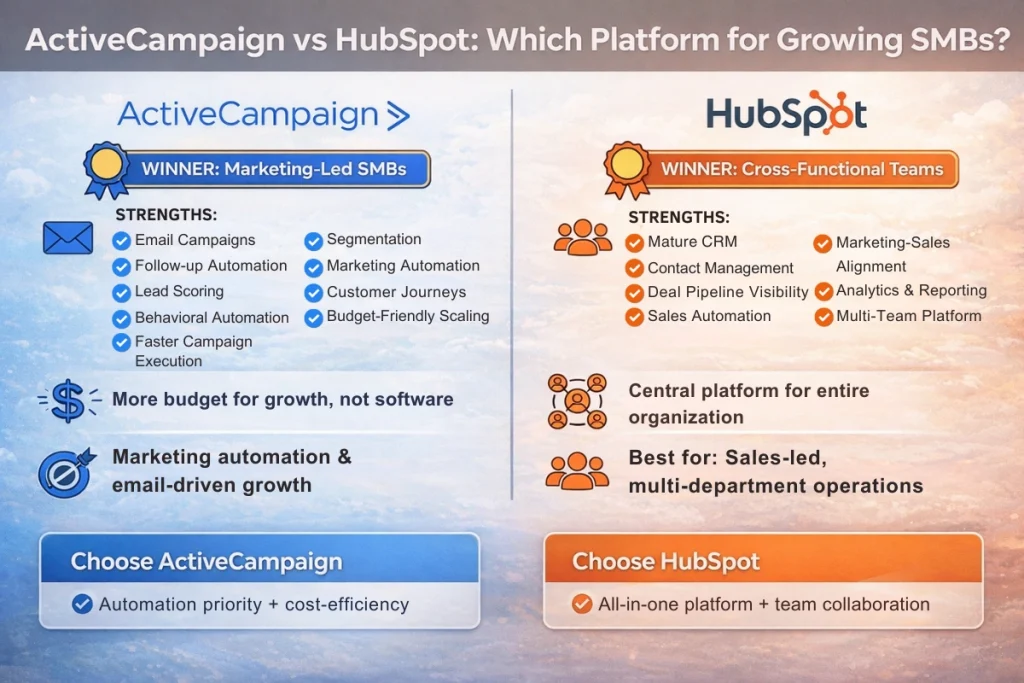
For most growing SMBs focused on email marketing and marketing automation, ActiveCampaign is usually the better overall fit.
That doesn’t mean HubSpot is weak.
Far from it.
HubSpot is one of the strongest all-in-one platforms on the market. It’s especially good if you want a broader system for customer relationship management, sales, service, and content management. But many smaller businesses don’t need the full weight of that ecosystem yet.
They need results.
More specifically, they need:
- better Email Campaigns
- stronger follow-up
- smarter lead scoring
- cleaner segmentation
- more effective automation
- better value as their contact lists grow
That’s where ActiveCampaign often feels like the smarter choice.
It’s more focused on the part many SMBs care about most: turning leads into customers through better email marketing, stronger marketing automation, and more flexible automation workflows.
This is great because it helps you spend more of your budget on growth, not just software overhead.
When is HubSpot the better choice?
HubSpot is often the better choice if you need a broader business platform, not just stronger email automation.
That includes businesses that want:
- a more mature CRM
- stronger contact management
- deeper visibility across the deal pipeline
- more advanced sales automation
- tighter alignment between marketing and sales
- stronger Analytics and Reporting
- a central platform for managing Customer Relationships across teams
That broader structure can be genuinely valuable.
If multiple people in your business need to work inside the same system every day, HubSpot starts to make a lot more sense.
So the short version is simple:
- Best for marketing-led SMBs: ActiveCampaign
- Best for sales-led, cross-functional teams: HubSpot
If your priority is stronger automation without enterprise-style pricing, ActiveCampaign is well worth a serious look.
ActiveCampaign or HubSpot: What’s the Biggest Difference?
The biggest difference is not the feature list
This is the part most comparison articles miss.
Both tools can handle email marketing. Both can support marketing campaigns. Both include forms, automation, CRM-style features, and increasingly, AI-powered tools.
But they are built around different priorities.
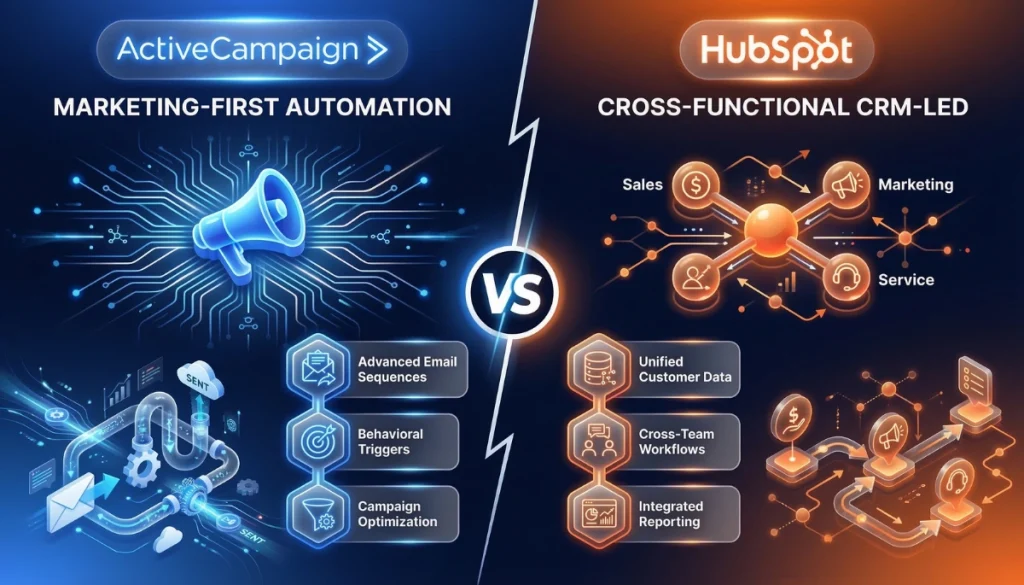
HubSpot is built around customer relationship management first.
ActiveCampaign is built around marketing execution first.
That single difference shapes almost everything else.
ActiveCampaign is Marketing-First
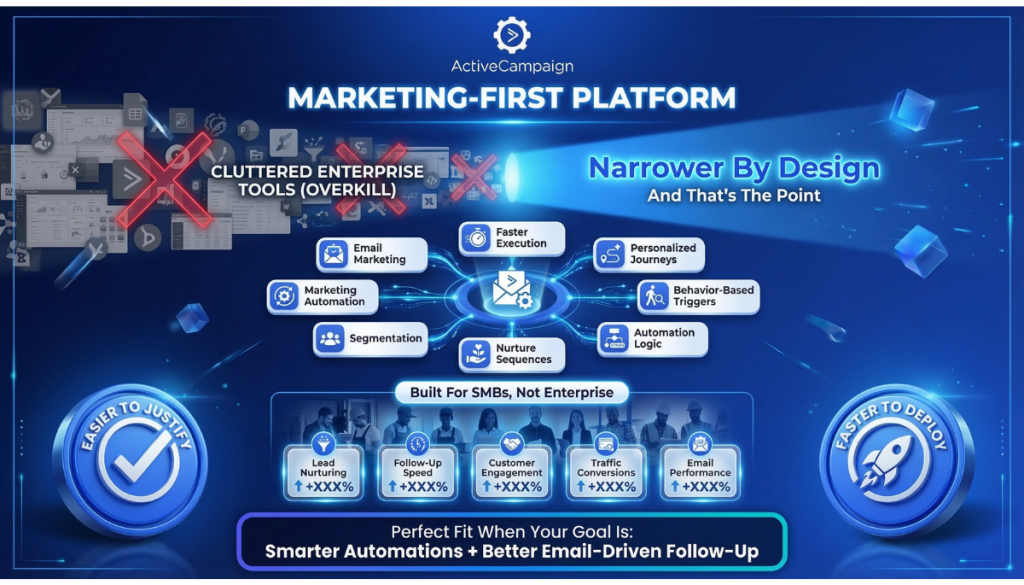
ActiveCampaign is narrower, but that’s often the point.
It’s built more around:
- email marketing
- marketing automation
- segmentation
- nurture sequences
- automation logic
- behavior-based triggers
- personalized customer journeys
- faster campaign execution
That focus matters because many SMBs are not trying to build a full enterprise stack.
They’re trying to improve:
- lead nurturing
- follow-up speed
- customer engagement
- conversions from their existing traffic
- the performance of their Email Campaigns
And for that kind of business, a more focused platform often feels easier to justify.
It can also feel faster to get working.
If your main goal is building smarter automations and better email-driven follow-up, ActiveCampaign is often the more natural fit.
ActiveCampaign Pros & Cons
Strong automation
Great email marketing
Flexible segmentation
Powerful lead scoring
Better value for SMBs
Easier to scale affordably
Strong ecommerce automation
CRM is less robust
Can feel complex at first
Fewer all-in-one tools
Less ideal for large teams
HubSpot is CRM-First
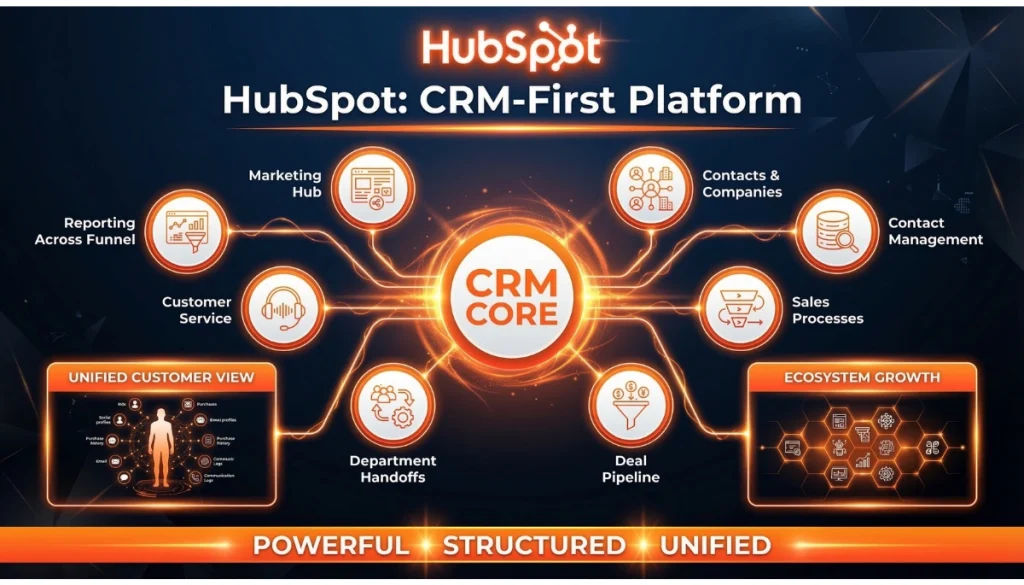
HubSpot is designed as a broader customer platform.
Its real strength is helping teams manage:
- contacts and companies
- contact management
- sales processes
- the deal pipeline
- handoffs between departments
- Customer Service
- reporting across the funnel
- content and website tools inside the wider Marketing Hub
That can be extremely powerful.
If your business needs stronger structure around Customer Relationships and a more unified view of customer data, HubSpot has a clear advantage.
It also becomes more compelling if you plan to use more of its ecosystem over time, including things like landing pages, sales automation, and advanced Analytics and Reporting.
HubSpot Pros and Cons
Excellent CRM
Strong sales tools
Great reporting
Polished interface
Strong team alignment
Broad all-in-one platform
Great for scaling teams
Expensive as you grow
Advanced features cost more
Can be overkill for SMBs
Less automation depth for the price
ActiveCampaign & HubSpot Pricing: The Real Cost of Advanced Automation
Which platform is cheaper?
At the entry level, both can look accessible. Once you need serious marketing automation, the gap gets much wider.
That’s the key pricing story.
And it’s where a lot of growing businesses get caught out.
On the surface, HubSpot can look like a low-cost way to get started. It offers a free CRM and discounted Starter offers at times, which is one reason so many businesses put it on their shortlist. But the real comparison starts when you move beyond the basics and need stronger marketing automation, better Analytics and Reporting, and more advanced tools for email marketing.
That’s where the difference in pricing structures becomes much more noticeable.
HubSpot can look affordable at the start
To be fair, HubSpot does have a real advantage here.
Its entry-level offers can be attractive for smaller teams that want a polished user interface, basic contact management, and a simple way to start with email marketing and landing pages.
HubSpot’s current pricing pages show:
- Starter Customer Platform promotional pricing can begin as low as $9/month per seat billed annually for the first year in some offers. (hubspot.com)
- HubSpot’s product catalog also lists Smart CRM Starter from $20/month per seat as standard pricing. (legal.hubspot.com)
That’s useful if you mainly want basic tools and a cleaner way to organise Customer Relationships early on.
But there’s a catch.
A lot of businesses comparing ActiveCampaign and HubSpot are not looking for “basic.”
They’re looking for better automation, better segmentation, stronger follow-up, and more control over how leads move through the funnel.
And that changes the pricing conversation completely.
HubSpot gets expensive once you need serious automation
If you want the kind of features many growing SMBs actually care about — things like more advanced automation workflows, deeper reporting, stronger sales automation, more sophisticated A/B testing, and more flexibility inside Marketing Hub — the jump is steep.
HubSpot’s current pricing pages show:
- Marketing Hub Professional starts at $890/month on monthly billing
- Or $800/month billed annually
- It also requires a $3,000 one-time Professional onboarding fee (hubspot.com )
That’s a very different buying decision from “cheap starter plan.”
And it matters because this is usually the point where a growing business wants to unlock the features that actually drive better results.
For example:
- more advanced Email Campaigns
- stronger lead scoring
- better contact management
- custom reporting
- better deal pipeline visibility
- more useful automation logic
- better performance tracking across marketing campaigns
If you’re not planning to use the broader HubSpot ecosystem deeply, that jump can feel hard to justify.
ActiveCampaign usually gives automation-focused SMBs better value sooner
This is where ActiveCampaign tends to become much more compelling.
Its current comparison and pricing pages show:
- Starter from $15/month
- Plus from $49/month
- Pro from $79/month
- Enterprise from $145/month
for accounts with 1,000 contacts on the comparison page. (activecampaign.com)
That does not mean ActiveCampaign is “cheap” in every scenario.
As your list grows, costs grow too. That’s true with most serious platforms.
But for many SMBs, the value equation is much stronger because you can access meaningful marketing automation, strong email marketing, and advanced workflow logic without needing to jump straight into near-enterprise pricing.
That’s a big deal.
Especially if you’re a business that mainly wants to improve:
- lead nurture
- customer engagement
- conversion from warm leads
- onboarding sequences
- webinar follow-up
- reactivation campaigns
- overall customer journeys
If your goal is better automation without a huge fixed software bill, ActiveCampaign is one of the strongest options to compare seriously.
Why pricing alone should not decide the winner
This is important.
A cheaper platform is not always the better platform.
If you genuinely need:
- stronger sales pipelines
- deeper Customer Service workflows
- more advanced Analytics and Reporting
- cross-team visibility
- a more centralised customer relationship management system
- a full Content Management System with broader website tools
…then HubSpot may still be worth the extra cost.
That’s the fair take.
The issue is not that HubSpot is overpriced for everyone.
The issue is that many smaller businesses buy HubSpot because it feels like the “safe” big-name choice, then end up using only a small slice of what they’re paying for.
That’s where the value starts to break down.
And that’s exactly where ActiveCampaign often wins.
ActiveCampaign and HubSpot Automation: Which Platform Is Better for Marketing Automation?
Which platform has better automation for growing SMBs?
For most growing SMBs focused on email marketing and lead nurturing, ActiveCampaign usually has the stronger edge in marketing automation.
That doesn’t mean HubSpot has weak automation.
It doesn’t.
HubSpot has powerful automation tools, especially when you’re using them alongside its CRM, deal pipeline, sales automation, and broader Marketing Hub features.
But if your main goal is building flexible, high-converting automation around email marketing, behavior triggers, and customer journeys, ActiveCampaign usually feels more purpose-built.
That’s the difference.
Why ActiveCampaign often feels stronger for automation-first teams
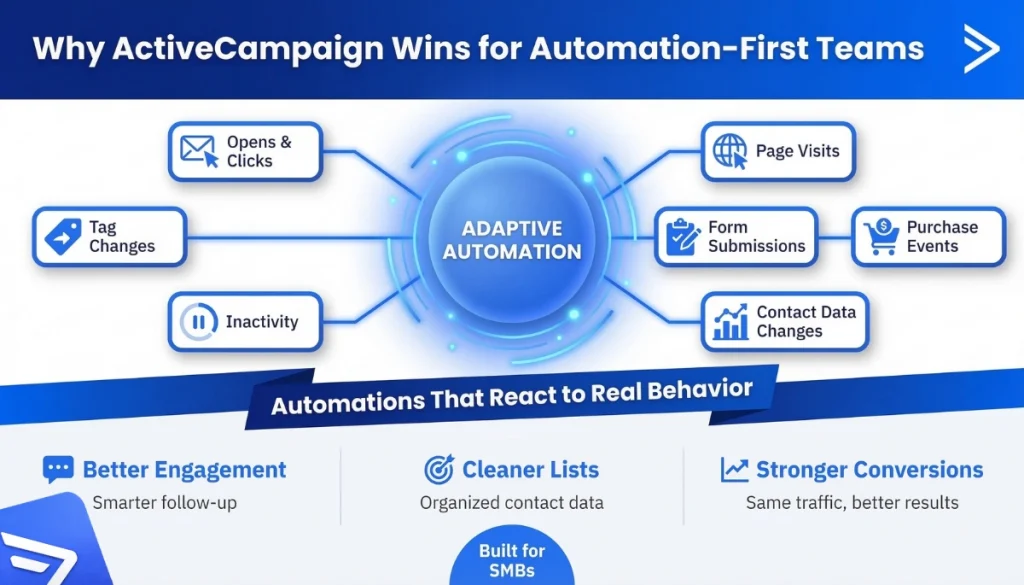
ActiveCampaign is built around the idea that your automations should adapt based on what people actually do.
That includes:
- opens and clicks
- page visits
- tag changes
- form submissions
- purchase events
- inactivity
- changes in contact data
This makes it easier to build more relevant automation workflows instead of one-size-fits-all blasts.
And for SMBs, that can be very powerful.
Because smarter follow-up usually means better customer engagement, cleaner list management, and stronger conversions from the same traffic.
HubSpot’s automation is still strong — just built differently
HubSpot’s automation tends to make the most sense when your workflows are tightly connected to:
- lifecycle stages
- CRM records
- handoffs between teams
- lead assignment
- deal pipeline movement
- sales automation
- broader Customer Relationships
That’s where it can be excellent.
So the cleanest way to think about it is this:
- ActiveCampaign = stronger for marketing-first automation
- HubSpot = stronger for cross-functional, CRM-led automation
And for the audience this article is written for — growing SMBs that want powerful automation without enterprise-style pricing — that usually tilts the comparison toward ActiveCampaign.
If your priority is building smarter follow-up and stronger email-driven automations, ActiveCampaign is well worth shortlisting.
ActiveCampaign or HubSpot Email Marketing: Which Platform Is Better for Email-First Businesses?
Which platform is better for email marketing?
If email is a major part of how your business generates leads and sales, ActiveCampaign is usually the stronger fit.
That’s one of the clearest differences in this comparison since ActiveCampaign is known as one of the strongest email marketing platforms out there.
HubSpot includes solid email marketing tools, and for some businesses they’ll be more than enough. But HubSpot is built as a wider platform, so email is one part of a much broader system.
ActiveCampaign is more focused.
And for many growing SMBs, that focus is exactly what makes it attractive.
Why ActiveCampaign often feels stronger for email-first teams
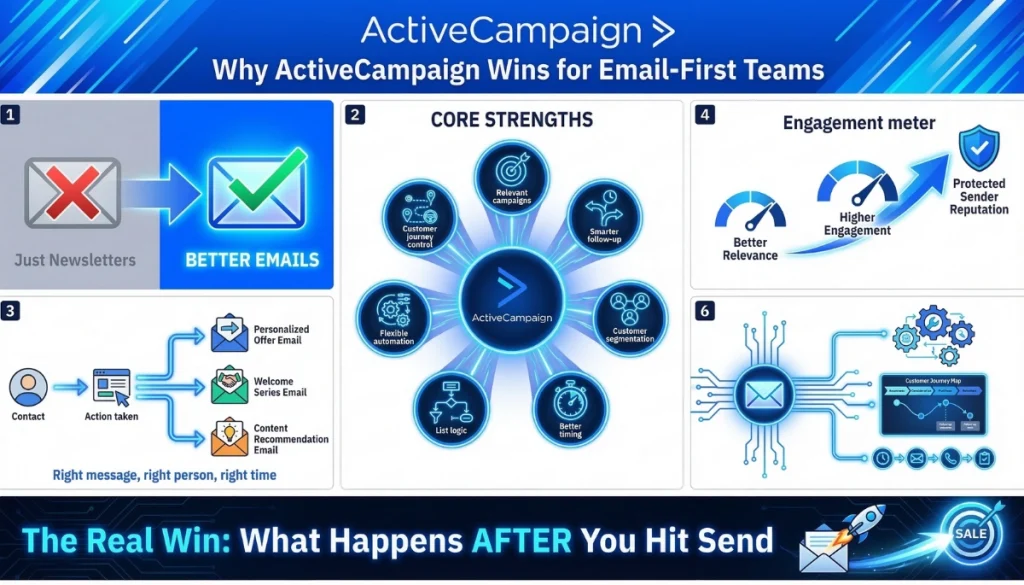
Most growing businesses do not just need to send newsletters.
They need to send better emails.
That usually means:
- more relevant Email Campaigns
- smarter follow-up
- stronger customer segmentation
- better timing
- cleaner list logic
- more flexible Email Automation
- more control over customer journeys
This is where ActiveCampaign tends to shine.
It’s built to help you send the right message based on what a contact actually does, not just blast the same message to everyone in your contact lists.
That’s useful because relevance usually improves engagement.
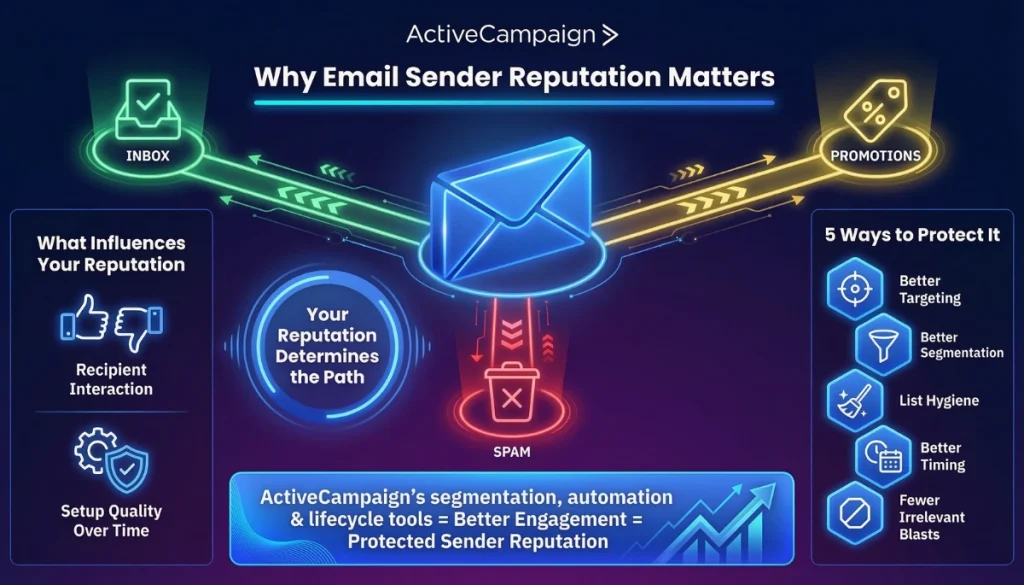
And better engagement helps protect your sender reputation, which matters far more than many people realise.
Email builder, email designer, and day-to-day campaign creation
This is a practical point that often gets overlooked.
When you’re sending regular campaigns, the experience inside the editor matters.
HubSpot has a polished interface and a good campaign creation experience. Its email builder is solid, especially if you’re already using the wider HubSpot ecosystem and want campaigns tied closely to CRM data, landing pages, and website assets.
ActiveCampaign is also strong here, and its focus is more obviously tied to campaign execution.
That means the email designer experience is not just about layout. It’s about how easily that email fits into a bigger automation or nurture flow.
This is great because your campaigns don’t live in isolation.
They live inside a system.
That’s why for many SMBs, ActiveCampaign’s approach can feel more useful in real life. The design tools matter, but the bigger win is how easily your emails connect to automation workflows, customer journeys, and follow-up logic.
What about email templates?
Both platforms offer email templates, and both can help you build professional-looking campaigns without needing a designer.
So this is not a major deciding factor on its own.
The real difference is what happens after the email is sent.
That’s where ActiveCampaign often pulls ahead for email-first businesses.
If your priority is not just “send a nice email” but “send a better email sequence that moves people closer to a sale,” ActiveCampaign tends to be the stronger fit.
ActiveCampaign and HubSpot Deliverability: What Actually Matters?
Which platform has better deliverability?
There is no honest way to say one platform guarantees better deliverability for every sender.
That would be misleading.
Deliverability depends on several factors, including:
- list quality
- domain setup
- authentication
- complaint rates
- engagement
- data hygiene
- sending habits
- content quality
- overall sender reputation
That’s the fair answer.
Still, platform infrastructure does matter. And if email marketing is central to your business, it’s worth taking seriously.
Third-party benchmarks and a fair interpretation
A widely referenced benchmark from EmailTooltester’s December 2025 deliverability test found an average deliverability rate of 83.1% across 15 email service providers, which shows that provider differences can be meaningful. (emailtooltester.com)
That doesn’t mean any one platform will outperform another for every account.
But it does support a practical takeaway:
If email performance is central to your business, you should care about more than just features.
You should also care about:
- deliverability culture
- workflow quality
- segmentation depth
- automation quality
- list hygiene
- how well the platform helps you send relevant emails
That’s why many email-first businesses still lean toward ActiveCampaign in this comparison.
What about email verification?
Neither platform should be chosen based only on built-in email verification expectations.
The smarter approach is to think of verification as part of a wider deliverability process, not a magic fix.
What matters more is whether the platform helps you maintain:
- cleaner lists
- better engagement
- stronger automation logic
- healthier sender reputation
And again, that’s an area where ActiveCampaign’s deeper email-first focus can be a real benefit.
If email is a major revenue channel for your business, ActiveCampaign is one of the strongest platforms to compare carefully.
Where HubSpot Genuinely Beats ActiveCampaign
Is HubSpot actually better in some important areas?
Yes — absolutely.
And this is where a fair review matters.
HubSpot is not just a more expensive version of ActiveCampaign.
It has real strengths.
In some business models, those strengths are significant enough to make it the better choice.
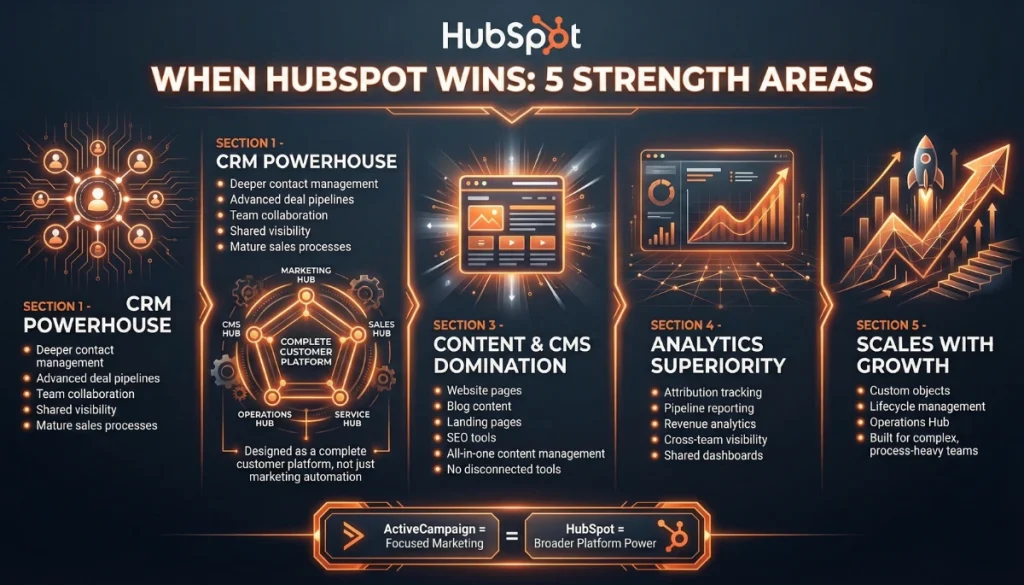
HubSpot is stronger for CRM depth and broader contact management
If your business needs a stronger CRM foundation, HubSpot usually has the edge.
It is generally better suited for:
- deeper contact management
- more structured Customer Relationships
- better visibility across a shared deal pipeline
- more advanced deal pipelines
- team collaboration around contacts and companies
- more mature sales processes
This matters most when multiple people in your business are working the same leads or accounts.
In that kind of setup, a stronger CRM backbone can improve visibility and reduce messy handoffs.
HubSpot is stronger for sales-led and cross-functional teams
This is one of HubSpot’s clearest win areas.
If your business relies on:
- multiple reps
- shared sales tools
- formal sales pipelines
- handoffs between marketing and sales
- more structured sales automation
- stronger Customer Service workflows
- reporting across teams
…then HubSpot becomes much more compelling.
That’s because it is designed as a wider customer platform, not just an email marketing and automation tool.
Its ecosystem can include:
- Marketing Hub
- Sales Hub
- Service Hub
- CMS Hub
- Operations Hub
For the right business, that all-in-one structure can be a genuine advantage.
Not just a nice extra.
HubSpot is stronger for content, CMS, and website management
This is one of the biggest areas where HubSpot clearly stands apart.
If your business wants more than just email marketing and marketing automation, HubSpot’s wider platform starts to look very appealing.
It can support:
- website pages
- blog content
- landing pages
- forms
- reporting
- content optimisation
- built-in SEO tools
- broader content management
That matters if you want fewer disconnected tools.
For some businesses, especially those leaning into Inbound Marketing, that all-in-one setup is a real advantage.
Instead of stitching together separate systems for pages, email, forms, CRM, and reporting, you can keep more of it under one roof.
That can make day-to-day management easier.
CMS Hub gives HubSpot a real edge for website-led businesses
If your website is a major part of your lead engine, HubSpot’s CMS Hub deserves real credit.
This is not just a simple page builder.
It’s part of a broader Content Management System strategy that can tie your website, forms, contact data, and automation together more tightly.
For businesses that want stronger CMS Capabilities, that can be a big deal.
HubSpot’s wider Content Management System approach can be especially useful if you care about:
- publishing blog content regularly
- managing pages without a separate WordPress setup
- keeping forms and contact capture tied closely to CRM records
- improving Website Traffic analysis inside the same ecosystem
- using website content as part of a broader Inbound Marketing process
That doesn’t automatically make HubSpot “better.”
But it does make it more attractive for businesses that want a wider platform, not just better automations.
HubSpot is stronger for analytics and reporting
This is another real win for HubSpot.
If your business needs more advanced Analytics and Reporting, HubSpot is usually stronger.
That includes areas like:
- attribution across the funnel
- shared dashboards
- sales and marketing visibility
- pipeline reporting
- revenue-focused reporting
- stronger web analytics
- cross-team performance visibility
This is where HubSpot can justify a higher price for the right business.
If leadership needs to understand how marketing, sales, and service are all affecting revenue, HubSpot’s broader platform can make that easier.
That’s especially true if you’re already using multiple hubs together.
In short:
- ActiveCampaign often wins on focused marketing execution
- HubSpot often wins on broader Analytics and Reporting
That’s the fair split.
HubSpot’s advanced ecosystem can matter more as you grow
Once a business becomes more complex, HubSpot’s broader feature set starts to make more sense.
That can include advanced things like:
- custom objects
- deeper sales process structure
- more formal lifecycle management
- wider Customer Data visibility
- more connected internal workflows
- operational support through Operations Hub
Those features are not essential for every SMB.
In fact, for many smaller businesses, they’ll be overkill.
But for the right company, they can become genuinely valuable over time.
That’s why HubSpot still deserves serious consideration in this comparison.
If your business is becoming more cross-functional and process-heavy, HubSpot may still be the better long-term fit.
ActiveCampaign versus HubSpot Comparison Table: Which Platform Wins on What?
If you’re skimming, this table gives you the short version.
It won’t tell the whole story, but it will help you see the main trade-offs quickly.
ActiveCampaign and HubSpot compared at a glance for growing SMBs
| Category | ActiveCampaign | HubSpot | Best Fit |
| Core focus | Email marketing + marketing automation | CRM + marketing + sales + service platform | Depends on business model |
| Best for | Marketing-led SMBs, lean teams, service businesses, email-first brands | Sales-led teams, larger SMBs, multi-department businesses | Depends on internal complexity |
| Entry pricing | Starts at $15/month for 1,000 contacts on current comparison page | Starter plans can begin low, depending on package and seat structure | ActiveCampaign for pure automation value |
| Advanced marketing pricing | Pro shown at $79/month for 1,000 contacts | Marketing Hub Pro starts at $890/month monthly | ActiveCampaign for automation-focused affordability |
| Email marketing depth | Excellent | Strong, but broader platform-first | ActiveCampaign |
| Automation capabilities | Excellent for SMBs and lifecycle marketing | Strong, especially for CRM-led workflows | ActiveCampaign for most SMB marketers |
| Contact management | Good for many SMBs | More mature and structured | HubSpot |
| Deal pipeline visibility | Good enough for many smaller teams | Stronger for shared sales processes | HubSpot |
| Sales automation | Solid, but not the main focus | Stronger for multi-rep teams | HubSpot |
| Content management | Limited compared to HubSpot | Stronger, especially with CMS Hub | HubSpot |
| Analytics & Reporting | Good, especially on higher tiers | Stronger overall across teams | HubSpot |
| AI-powered tools | Strong and increasingly automation-focused | Broad across a wider ecosystem | Tie, but different strengths |
| Time-to-value for marketing-led SMBs | Usually faster | Often slower if using the wider platform | ActiveCampaign |
| Best overall for growing SMBs focused on automation | Yes | Sometimes, depending on wider needs | ActiveCampaign |
That’s the quick version.
Now let’s look at what the day-to-day experience actually feels like once you’re inside the software.
ActiveCampaign or HubSpot Ease of Use: Which Platform Gets Results Faster?
Which platform is easier to use?
For most marketing-focused SMBs, ActiveCampaign is usually faster to get useful results from.
That’s the better way to frame it.
Because “easy to use” can mean different things.
A platform can look simple at first, but still take much longer to set up properly for real business use.
So instead of asking:
Which platform looks easier?
A better question is:
Which platform helps you get useful results faster for the job you actually need done?
For many SMBs comparing ActiveCampaign against HubSpot, that answer is often ActiveCampaign.
Why ActiveCampaign often feels faster to get value from
If your goal is mainly to improve email marketing, build smarter automation workflows, and run better Email Campaigns, ActiveCampaign usually gives you a more direct path.
Most lean businesses want to do things like:
- capture leads
- segment contacts
- trigger follow-up
- build nurture sequences
- improve lead generation
- automate reminders
- move people through a simple sales funnel
That’s where ActiveCampaign often feels more natural.
You’re not being pushed into a much wider system unless you need it.
That’s useful because it reduces setup drag.
And for a growing business, less drag often means faster execution.
HubSpot can feel simple early on — but heavier as your setup expands
To be fair, HubSpot has a polished interface and a strong reputation for usability.
Its user interface is one of the reasons so many businesses like it.
For basic tasks, it can feel clean and intuitive.
But once you start using more of the platform, the setup often gets heavier.
That’s because you’re not just learning an email tool.
You’re often learning a wider system that may involve:
- contact records
- lifecycle stages
- forms
- landing pages
- deal management
- handoffs between teams
- reporting dashboards
- content management
- customer service workflows
That’s not a weakness.
It’s just the reality of a broader platform.
For the right business, that broader structure is valuable.
For many SMBs, though, it can feel like more software than they actually need right now.
If your main goal is better marketing execution rather than broader platform complexity, ActiveCampaign often feels like the quicker win.
ActiveCampaign and HubSpot AI Features: Which Platform Is Smarter in 2026?
Which platform has better AI?
Both platforms are investing heavily in AI, but they’re solving slightly different problems.
That’s the honest answer.
This is not a category where one platform clearly crushes the other.
Instead, it comes down to what kind of help you actually want from AI.
If you want AI spread across a wider business platform, HubSpot is strong.
If you want AI that helps you build and improve marketing automation, Email Campaigns, and customer journeys faster, ActiveCampaign often feels more relevant for a growing SMB.
That distinction matters.
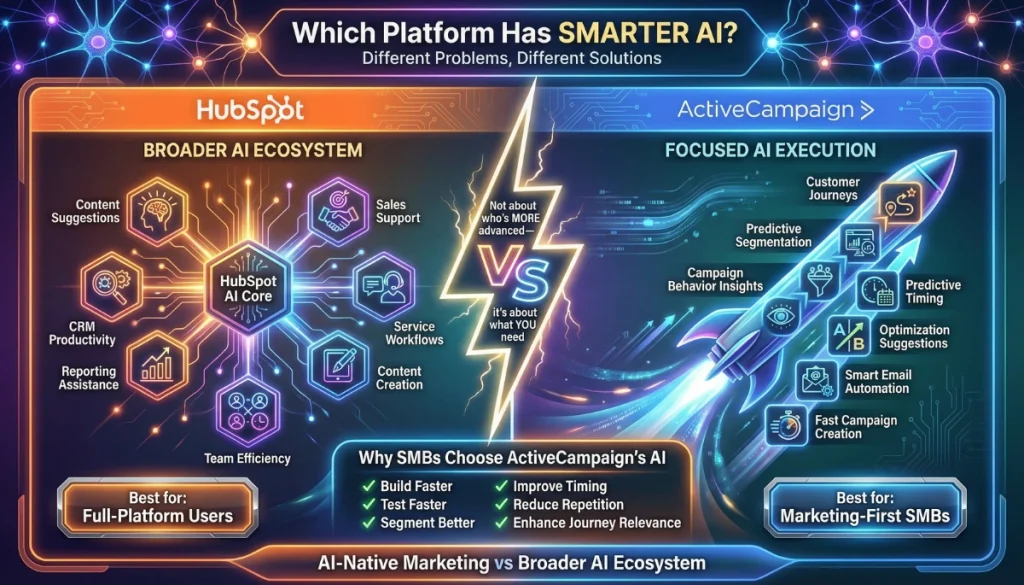
HubSpot’s AI is broader across the platform
HubSpot’s AI strategy makes sense for the kind of product it is.
Because HubSpot is a wider platform, its AI features are designed to support more than just email or automation. They can touch:
- content suggestions
- CRM productivity
- reporting assistance
- sales support
- service workflows
- broader Content Creation
- internal efficiency across teams
That can be genuinely useful if your business is using more of the full ecosystem.
If your team relies on Marketing Hub, Sales Hub, and Service Hub together, broader AI support can create a better overall customer experience and help improve internal workflows across departments.
For the right business, that’s valuable.
ActiveCampaign’s AI is more focused on execution
ActiveCampaign’s AI story is narrower, but for many SMBs, that’s exactly why it stands out.
It’s not trying to be an all-purpose business assistant.
It’s trying to help marketers get campaigns live faster and improve them with less manual work.
That’s a much more practical angle for many smaller teams.
In real terms, ActiveCampaign’s AI-focused direction is built around things like:
- faster campaign creation
- smarter Email Automation
- optimisation suggestions
- predictive timing
- stronger predictive segmentation
- insights tied to real campaign behaviour
- support for better customer journeys
This is useful because most SMBs don’t need AI everywhere.
They need AI where it saves the most time.
And that is often in campaign execution.
AI-Native solutions vs broader AI ecosystems
This is a helpful way to frame it.
HubSpot often feels like a broader AI ecosystem inside a bigger platform.
ActiveCampaign increasingly feels like one of the more focused AI-Native solutions for marketers who care most about automation, segmentation, and execution.
That does not mean ActiveCampaign is “more advanced” in every AI category.
That would be too simplistic.
But for a lean business that wants AI to directly improve marketing automation, customer journeys, and follow-up, it can feel more immediately useful.
That’s why ActiveCampaign’s current positioning around AI-powered tools and autonomous campaign execution feels especially relevant for this audience.
Why this matters for growing SMBs
A lot of AI features sound exciting in demos.
But in real life, the question is simple:
Does this help you save time, improve results, or reduce manual work?
For many growing businesses, the most valuable AI use cases are:
- building faster
- testing faster
- segmenting better
- improving timing
- reducing repetitive work
- improving relevance across customer journeys
That’s where ActiveCampaign’s direction feels strong.
Especially for smaller teams without a full ops department.
If you want AI that helps you execute smarter marketing faster, ActiveCampaign is one of the most relevant platforms to look at.
ActiveCampaign or HubSpot for Different Business Types: Which One Fits Your Business Best?
This is where the decision gets much easier.
Because the “best” platform changes depending on how your business actually works.
That’s why blanket statements like “HubSpot is better” or “ActiveCampaign is better” are not very helpful.
The smarter question is:
Which one fits your business model, team size, and growth stage best?
ActiveCampaign or HubSpot for Coaches, Consultants, and Service Businesses
Which platform is better for service-based businesses?
For most coaches, consultants, and service businesses, ActiveCampaign is usually the better fit.
Why?
Because these businesses often care most about:
- lead capture
- nurture sequences
- booking calls
- automated follow-up
- list segmentation
- lead qualification
- a simple sales funnel
- better lead generation
They usually do not need a huge, enterprise-style CRM setup with complex deal pipelines, service teams, and advanced operational layers.
That’s where ActiveCampaign often makes more sense.
It gives you the tools to improve follow-up, increase customer engagement, and run smarter automation without forcing you into a much larger stack.
That can be a very good trade-off for a lean business.
When HubSpot might still make sense for service businesses
HubSpot can still be a strong fit if your service business has:
- multiple sales reps
- a longer sales cycle
- several offers or departments
- a formal deal pipeline
- stronger needs around sales automation
- heavier internal collaboration
At that point, HubSpot’s broader structure can become more useful.
But for many smaller service businesses, that level of complexity is not essential yet.
That’s why ActiveCampaign often feels like the more practical choice.
HubSpot or ActiveCampaign for SaaS and Online Businesses
Which platform is better for lean SaaS businesses?
For many lean SaaS businesses and online-first brands, ActiveCampaign is often the stronger fit.
That’s especially true if your growth depends on:
- lead magnets
- trial nurture
- onboarding sequences
- product education emails
- reactivation flows
- upsell and retention campaigns
- behaviour-based customer journeys
In those cases, marketing automation is not just a side feature.
It’s a core growth lever.
And when that’s true, ActiveCampaign’s strengths become very relevant.
It’s built to support:
- triggered follow-up
- better segmentation
- smarter nurture
- stronger predictive segmentation
- more flexible campaign logic
- easier optimisation of customer journeys
That’s often more valuable to a lean SaaS business than paying for a much wider platform before the business really needs it.
When HubSpot makes more sense for SaaS
HubSpot can become more compelling if your SaaS company is:
- sales-led rather than self-serve
- using multiple reps or account executives
- managing a more complex deal pipeline
- focused on RevOps maturity
- relying heavily on shared Customer Data
- needing stronger Analytics and Reporting across teams
At that point, HubSpot’s broader architecture may justify the higher cost.
But if your SaaS growth is still mainly driven by marketing, onboarding, and lifecycle automation, ActiveCampaign often remains the stronger value play.
HubSpot and ActiveCampaign for Agencies and B2B Teams
Which platform is better for agencies?
This depends on the kind of agency.
If you run a lean agency or consultancy that mainly wants to:
- capture leads
- nurture prospects
- send better Email Campaigns
- automate reminders
- book calls
- improve follow-up
…then ActiveCampaign is often the better fit.
It gives you strong marketing automation and solid contact management without the overhead of a much broader system.
But if you run a bigger agency or B2B team with:
- multiple account managers
- shared deal pipelines
- formal sales stages
- stronger sales automation
- broader reporting needs
- heavier internal collaboration
…then HubSpot becomes much more compelling.
That’s where its stronger CRM depth, deal pipeline structure, and broader sales tools start to matter more.
The honest split for B2B teams
For B2B teams, the cleanest answer is this:
- Marketing-led B2B SMBs: often ActiveCampaign
- Sales-led B2B teams with multiple reps: often HubSpot
That’s the fairest way to compare them.
And for many readers, it’s also the most useful.
If your business is still marketing-led and you want stronger automation without jumping into a much bigger platform, ActiveCampaign is usually the more practical place to start.
ActiveCampaign or HubSpot for Ecommerce Brands and Online Stores
Which platform is better for ecommerce businesses?
For many small and mid-sized ecommerce brands, ActiveCampaign is often the better fit if email and automation are major revenue drivers.
That’s because a lot of ecommerce growth comes from lifecycle email, not just one-off campaigns.
In practical terms, that usually means:
- abandoned cart follow-up
- post-purchase sequences
- win-back campaigns
- cross-sell and upsell flows
- smarter segmentation
- better timing
- more personalised customer journeys
That’s where ActiveCampaign often feels like a strong match.
Its deeper automation focus can be very useful when your goal is to improve repeat purchases and increase customer engagement without adding unnecessary platform weight.
Ecommerce integrations matter more than most people think
For ecommerce brands, it’s not just about sending emails.
It’s about how well your platform connects to your store and customer data.
That includes things like:
- product triggers
- order events
- abandoned carts
- purchase history
- post-purchase automation
- re-engagement sequences
This is where E-commerce integrations become important.
ActiveCampaign supports a wide range of integrations with popular e-commerce platforms, which makes it easier to build more relevant follow-up based on actual buyer behaviour. (activecampaign.com)
That’s useful because better timing and relevance usually lead to stronger results.
When HubSpot might still make sense for ecommerce
HubSpot can still be a strong choice for ecommerce brands if the business is more complex and needs:
- broader reporting
- deeper CRM visibility
- stronger sales coordination
- website and content tools in one place
- more centralised Customer Data
- a wider content and platform strategy
If your ecommerce business is becoming more multi-team and less purely email-driven, HubSpot may be worth the extra investment.
But for many smaller ecommerce brands, the more focused automation-first approach often makes more sense.
How ActiveCampaign and HubSpot Compare to Other CRM and Automation Tools
This article focuses on comparing ActiveCampaign with HubSpot, but some businesses will also be looking at alternatives.
That’s fair.
Depending on your needs, tools like Zoho CRM or Freshsales Suite may also come up in your research.
Where Zoho CRM fits in
Zoho CRM is often attractive for businesses that want a broad set of business tools at a competitive price.
It can be a decent option if your main priority is CRM breadth and you already like the wider Zoho ecosystem.
That said, when the conversation is specifically about email marketing and marketing automation depth, ActiveCampaign often feels more purpose-built.
So while Zoho CRM can make sense for some businesses, it’s not always the strongest choice if automation and email performance are your main priorities.
Where Freshsales Suite fits in
Freshsales Suite can also be appealing for businesses that want a more sales-oriented platform with built-in CRM and communication tools.
For some teams, Freshsales Suite is a reasonable middle ground between simpler CRMs and bigger all-in-one systems.
But again, if your main focus is stronger email marketing, smarter automation workflows, and more flexible lifecycle automation, ActiveCampaign often remains the more focused option.
That’s why many businesses comparing Zoho CRM, Freshsales Suite, and HubSpot still end up narrowing the real decision down to ActiveCampaign or HubSpot.
A quick note on “project module” expectations
It’s also worth saying this clearly:
Neither ActiveCampaign nor HubSpot should really be chosen because you want a strong project module.
If you need true project management, task tracking, or a dedicated project module workflow, you’ll usually be better off pairing your CRM or automation platform with a specialist tool.
That’s important because some buyers expect an all-in-one platform to do everything.
In reality, the best setup often comes from choosing the right core platform, then connecting it to the right supporting tools.
When to Choose ActiveCampaign Instead of HubSpot
Choose ActiveCampaign if your priority is stronger marketing execution
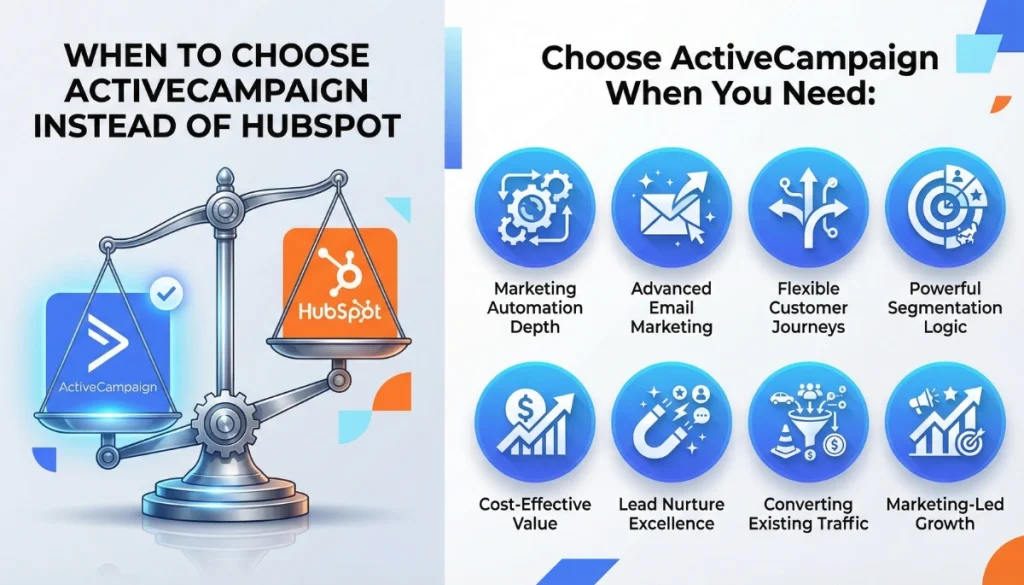
If your main goal is to improve how leads are captured, nurtured, and converted, ActiveCampaign is usually the smarter buy.
That’s the clearest way to frame it.
You’ll often get more value from ActiveCampaign if you want:
- deeper marketing automation
- stronger email marketing
- better Email Automation
- more flexible customer journeys
- stronger segmentation and automation logic
- easier optimisation of customer interactions
- better value before costs jump too high
This is especially true if your business is:
- marketing-led
- running lead magnets or webinars
- relying on nurture and follow-up
- trying to improve conversion from existing traffic
- still keeping software costs lean
That’s where ActiveCampaign tends to shine.
It gives many SMBs the tools they actually need without forcing them into a much broader system than they’re ready for.
Why ActiveCampaign often feels like the better value play
A lot of growing businesses don’t need a huge software stack.
They need a better way to:
- capture leads
- follow up faster
- improve relevance
- build smarter automation
- support sustainable growth
That’s why ActiveCampaign often feels like the stronger value play.
You’re paying for focused capability, not just wider complexity.
If your business is mainly trying to improve follow-up, conversion, and email-driven growth, ActiveCampaign is one of the best platforms to compare side by side.
When to Choose HubSpot Instead of ActiveCampaign
Choose HubSpot if your business needs a broader operating system
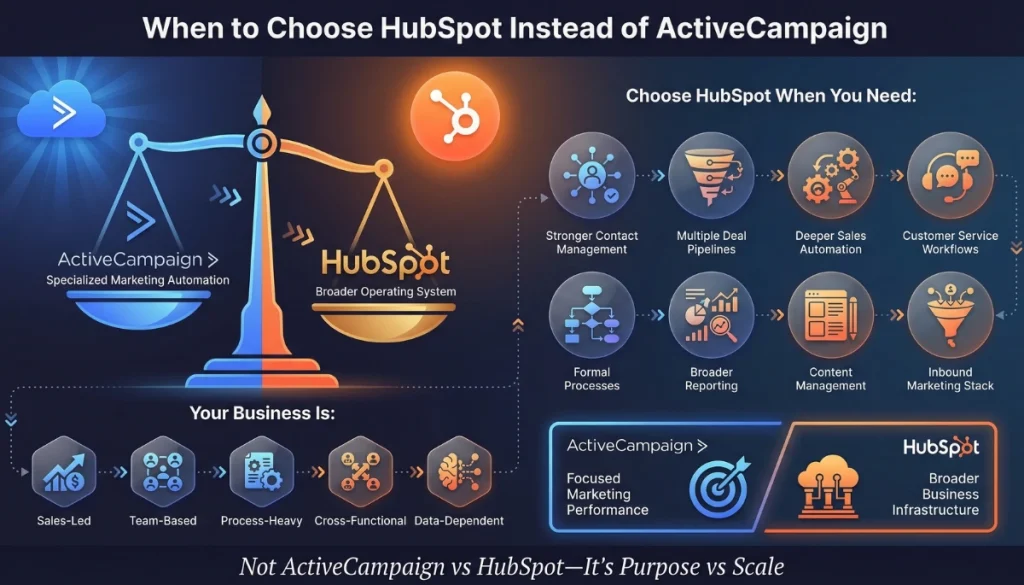
HubSpot becomes the better choice when your business is not just buying an email platform.
You’re buying a wider operating system for how the business runs.
That usually means HubSpot makes more sense if you need:
- stronger contact management
- multiple shared deal pipelines
- deeper sales automation
- stronger Customer Service workflows
- more formal sales and service processes
- broader Analytics and Reporting
- more integrated content management
- a wider Inbound Marketing stack
That’s where HubSpot’s bigger ecosystem becomes a genuine advantage.
HubSpot is still an excellent platform
It’s worth saying this plainly.
HubSpot is a genuinely strong product.
In fact, for some businesses, it is absolutely the better long-term choice.
If your business is becoming more:
- sales-led
- team-based
- process-heavy
- cross-functional
- dependent on broader reporting and shared customer records
…then HubSpot may be worth the higher cost.
That’s why this should never be framed as “ActiveCampaign good, HubSpot bad.”
That would be simplistic.
The smarter conclusion is:
- ActiveCampaign is often better for focused marketing performance
- HubSpot is often better for broader business infrastructure
That’s a much more honest and useful way to compare them.
Frequently Asked Questions About ActiveCampaign Compared To HubSpot
Is ActiveCampaign better than HubSpot?
For most growing small and mid-sized businesses focused on email marketing and marketing automation, ActiveCampaign is often the better fit. It usually offers stronger automation depth and better value at lower price points.
HubSpot is often the better choice for businesses that need a broader platform for CRM, sales, service, and reporting across teams.
Is HubSpot more expensive than ActiveCampaign?
Yes, HubSpot is usually more expensive once you need advanced marketing features. HubSpot Marketing Hub Professional currently starts at $890/month on monthly billing (or $800/month annually) and includes a required $3,000 onboarding fee, while ActiveCampaign’s comparison page currently shows plans from $15/month, with Pro at $79/month for 1,000 contacts.
Which platform is better for email marketing: ActiveCampaign or HubSpot?
ActiveCampaign is usually the stronger choice for email marketing if email is a major growth channel for your business. It is more focused on segmentation, automation, and behaviour-based follow-up.
HubSpot includes solid email tools, but email is one part of a broader platform built around CRM, content, sales, and service.
Which platform is better for CRM: HubSpot or ActiveCampaign?
HubSpot is usually stronger for CRM and sales process management. It offers deeper pipeline management, more advanced reporting, and a broader ecosystem for sales, service, and customer data. ActiveCampaign includes CRM features, but its main strength is marketing execution rather than full CRM depth.
Is ActiveCampaign easier to use than HubSpot?
For marketing-focused SMBs, ActiveCampaign is often faster to get useful results from because it is more focused on automation and campaign execution.
HubSpot has a polished interface, but it can become more complex as you start using more of its wider platform, especially across CRM, reporting, content, and service tools.
Which is better for small businesses: ActiveCampaign or HubSpot?
For most small businesses that want better automation, stronger email follow-up, and lower software overhead, ActiveCampaign is usually the better fit.
HubSpot can still be a strong choice for small businesses that need a more structured CRM, multiple pipelines, or a broader all-in-one platform and are prepared for higher costs as they grow.
ActiveCampaign or HubSpot: Final Verdict
Both ActiveCampaign and HubSpot are excellent platforms, but they’re built for slightly different types of businesses.
If you want a broader all-in-one system for CRM, sales, service, and content, HubSpot is a strong choice. But for most growing SMBs focused on email marketing, marketing automation, and getting better results without paying for a much larger platform than they need, ActiveCampaign is usually the better fit.
If your business is marketing-led and your priority is stronger automation, smarter follow-up, and better value as you grow, ActiveCampaign is the platform I’d recommend most often. It gives many smaller businesses the tools they actually need without the extra cost and complexity that can come with HubSpot’s wider ecosystem.
If that sounds like your business, it’s well worth taking a closer look at ActiveCampaign first.